An empty cinema ticket booth tells one story. Add muffled applause from behind the auditorium doors, and it tells another. Nobody has entered the picture, yet the building now seems occupied. The audience imagines a room the camera has never shown.
This is a useful idea for short AI videos, where adding more locations and characters can make a simple concept harder to follow. A frame does not have to contain the whole fictional world. It needs enough clues for viewers to believe that something continues beyond its edges.
Wan 3.0 AI Video Generator offers text- and image-led video generation with audio, making it relevant to scenes built around that relationship. Instead of asking only what the camera should show, a creator can describe what should be heard from elsewhere. The aim is a connected scene, not merely a striking image with music attached.
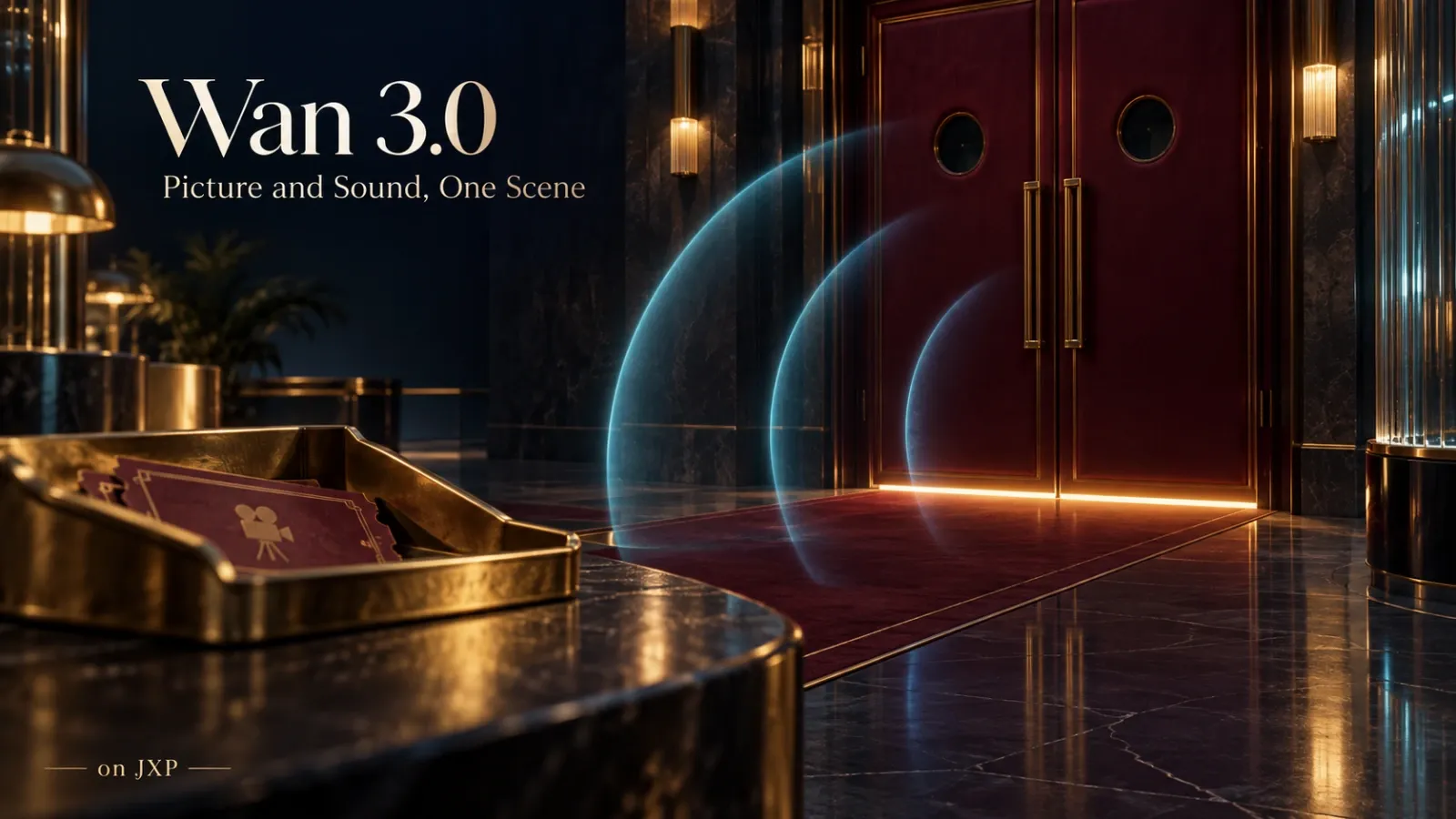
Consider an original teaser set in an invented neighbourhood cinema. The visible set is modest: a brass ticket tray, a booth and closed doors. Everything else must earn its place through a clue.
The frame is a boundary, not the edge of the world
A doorway gives the viewer a mental route into another space. A corridor disappearing around a corner does something similar. Even without showing the next room, these features suggest that the set extends beyond the visible rectangle.
The cinema needs one convincing connection: the booth faces the auditorium entrance. Put the doors somewhere viewers can locate easily, rather than surrounding the booth with unrelated decorative arches. When applause is heard, the picture should already offer a plausible place for it to come from.
There is no need to reveal a crowd. Showing the audience would answer a question that the closed doors can keep interesting. It would also change the job from establishing a place to directing a group of people.
Give an unseen event a visible consequence
Sound alone can suggest activity, but a small response in the picture helps connect it to the scene. A faint vibration in the ticket tray could accompany a distant rumble. A narrow shadow crossing the floor might suggest someone passing outside the shot. A door moving slightly could explain why the sound suddenly becomes clearer.
Choose the consequence carefully. Applause would not ordinarily make a heavy brass tray jump. A dramatic movement without a believable cause makes the scene feel magical, whether or not that was intended. For an ordinary cinema, a modest change in light beneath a door may be enough.
Different clues create different stories:
| Clue | What it suggests | What would confuse it |
| Muffled applause behind closed doors | A screening or performance is ending | Applause that sounds as close as the ticket tray |
| A passing shadow near the entrance | Someone is moving just outside view | A shadow with no plausible light source |
| Rain beyond the foyer | A wet street outside the building | Interior surfaces becoming wet for no reason |
These are alternative directions, not ingredients to combine automatically. Rain, footsteps, applause and a mysterious rumble could each work. Put them all into one brief and the viewer may struggle to identify the important event.
Write the room you cannot see
A prompt that says “cinematic atmosphere” leaves the relationship between rooms unspecified. Describe the visible space first, then place the unseen event relative to it. For the cinema, an illustrative direction could be:
A fixed view across an empty art-deco cinema foyer, with a brass ticket tray in the foreground and closed auditorium doors behind it. Muffled applause comes from inside the auditorium. A thin line of warm light beneath the doors brightens slightly. Keep the foyer empty and the camera outside the auditorium. No dialogue or music.
This is a proposed brief, not a tested output. Its useful detail is the separation between “here” and “there.” The sound belongs behind the doors; the camera stays in front of them. The light supplies a visual connection without revealing the people inside.
If the generator opens the doors and cuts to a cheering crowd, it may produce an attractive clip while missing the idea. A more elaborate result is not necessarily a more faithful one. The unseen room is part of the composition precisely because it remains unseen.
Listen for distance, not just a sound effect
Wan 3.0 video with audio lets the initial draft explore picture and sound together. For this scene, the useful question is whether the applause feels separated from the foyer. Generating both does not guarantee the right balance, timing or sense of distance.
Listen without looking at the screen. Does the applause seem to fill a large space, or does it resemble a small group standing beside the microphone? Is it muffled enough to belong behind a door? Then watch again: do the visible clues support what the soundtrack implies?
A single distracting voice can shift attention away from the imagined crowd. Likewise, an unexpected musical swell may tell viewers how to feel before the setting has done its work. If the generated soundtrack does not suit the scene, replace or reshape it in an editor rather than rebuilding a useful picture solely to keep the original sound.
Make the idea survive a smaller screen
A wide composition might place the tray on one side and the doors on the other. Cropping it into a narrow vertical frame can remove the very connection the scene depends on. Decide where the clip will appear before committing to the layout. A vertical version may need the tray lower in the foreground and the doors directly behind it.
Muted playback raises a different problem. The light under the door still suggests activity, but it cannot explain applause. If that information is essential, add a concise sound caption in the final edit. The scene need not communicate exactly the same mood without audio, but it should not become unintelligible.
Keep the cinema invented and its artwork original or cleared for the intended use. A recognisable movie poster or copied soundtrack would pull attention towards an existing film instead of the new story. The point is to suggest a world, not borrow one without permission.
End with a meaningful change: the applause fades, or the light beneath the doors goes out. Either can imply that an event has finished without showing it. A small set feels larger when the audience understands what lies beyond it—not when the camera insists on revealing every room.