
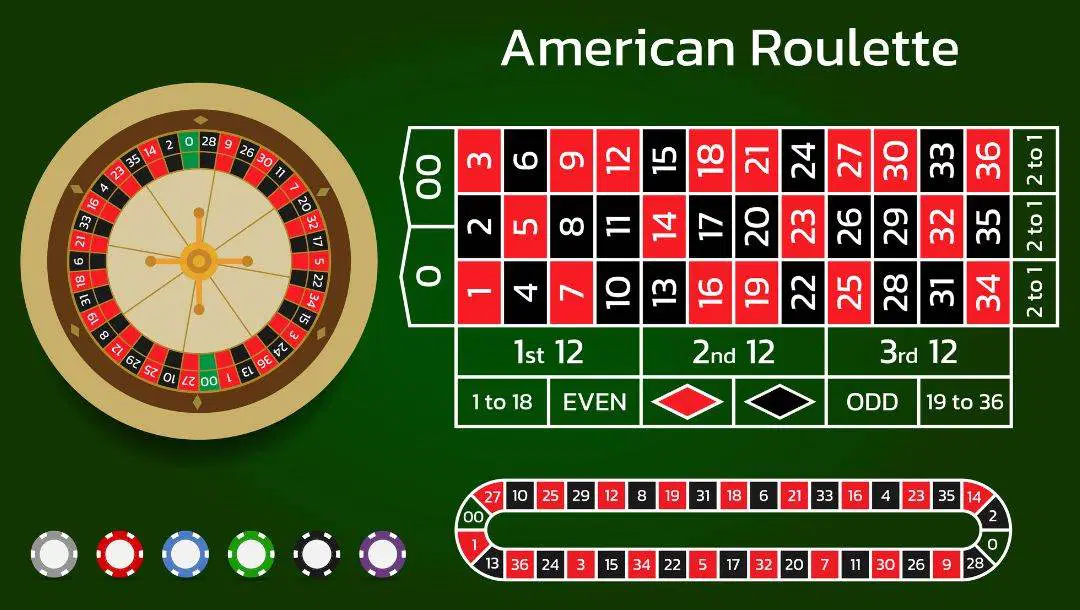
The Thai title asks, in essence, how betting on European and American roulette differs when you choose tables on UFABET168. The core distinction is mechanical rather than cosmetic: one extra pocket on the American wheel nearly doubles the house edge, which quietly changes the long‑term behavior of any betting approach that plays many spins.
Why comparing European and American roulette matters
At a glance, both versions share the same wheel shape, the same bet names, and the same payouts, which tempts players to treat them as interchangeable. However, the extra double‑zero pocket on the American wheel slightly lowers the chance of every non‑zero bet winning, magnifying the casino’s advantage over time even though each spin still feels identical.
This difference becomes crucial for players who repeat similar wagers across long sessions, because the higher house edge on the American layout means that the expected loss per unit bet grows almost twice as fast as on the European one. Understanding that cause–effect relationship is the foundation for making rational variant choices instead of simply following table graphics or dealer style.
Structural differences between the two wheels
The fundamental structural gap is pocket count: European roulette has 37 pockets (numbers 1–36 plus a single zero), while American roulette has 38 (1–36, zero, and double zero). Both zeros are losing outcomes for standard outside bets, so adding 00 increases the proportion of spins that defeat even‑money wagers without improving any base payout.
Number order around the rim also differs, reflecting distinct design traditions that distribute red/black and odd/even in slightly different sequences. While this ordering shapes how “neighbor” bets and visual sectors look, it does not by itself create better odds on one side of a fair wheel; the house edge ultimately comes from the count of green pockets rather than the sequence in which numbers appear.
How house edge and probabilities diverge
House edge measures the average percentage the casino expects to keep from each unit wagered over many spins, and it changes significantly between these variants. On European tables, the presence of only one zero produces a house edge of about 2.7%, whereas the American double‑zero wheel raises that figure to roughly 5.26%.
Because payouts remain the same—35:1 for a straight number, 1:1 for red/black, and so on—the additional green pocket simply reduces the probability that any non‑zero bet will succeed. The impact becomes more visible in long play, where the higher American house edge accelerates the expected rate at which a stable staking plan turns over funds to the casino.
Odds comparison by common bet type
To see the difference more concretely, consider how hit probabilities shift for standard bets when moving from a single‑zero wheel to a double‑zero one.
| Bet type | European hit chance | American hit chance |
| Even‑money (red) | 48.6% | 47.4% |
| Dozen | 32.4% | 31.6% |
| Column | 32.4% | 31.6% |
| Corner | 10.8% | 10.5% |
| Straight number | 2.7% | 2.6% |
The gaps in each row look small, but they compound when repeated across hundreds of spins, translating into a noticeable difference in expected bankroll trajectory. For a player running the same system on both variants, the American wheel’s slightly lower win rates mean that hot streaks must be stronger or more frequent just to offset a steeper underlying disadvantage.
Rules and special bets that separate the variants
Beyond pocket count, certain rules and optional bets exist only in one version or are strongly associated with it, which further distinguishes how sessions unfold. European (and especially French) tables may feature rules like “la partage” or “en prison” on even‑money wagers, returning or holding half the stake when the ball lands on zero, effectively cutting the house edge in those situations.
American layouts, by contrast, introduce a unique “five‑number bet” on 0‑00‑1‑2‑3 that carries an even worse house edge—around 7.89%—and do not typically offer compensating rules that soften the impact of zero outcomes. From an odds interpretation perspective, this means American tables not only start at a higher disadvantage, but can penalize some specific wagers even more harshly than their European counterparts.
How European and American tables are presented on UFABET168
When a player logs in and browses roulette options, the difference between European and American tables appears in labels, wheel graphics, and rule descriptions, but both are framed as equally legitimate ways to play. The key is that the lobby view and table info panels quietly embed the critical numbers—pocket count, minimums, maximums, and sometimes house edge—without explicitly telling users which game is more mathematically forgiving.
In scenarios where a user wants to move from abstract knowledge to actual table selection within a single account, พนันรูเล็ต acts as more than a generic login: it functions as a betting interface that gathers multiple wheel variants, bet limits, and live rooms onto organized menus, so the decision to prefer European or American roulette becomes part of a broader navigation problem, balancing familiarity with interface layout, preferred dealers, and the statistical trade‑offs tied to each rule set.
Bankroll behavior on each variant from a long-term view
Because the American house edge is almost double the European one, any fixed staking plan depletes funds more quickly on the double‑zero wheel when played over comparable numbers of spins. For example, a user flat‑betting the same stake on even‑money outcomes should expect, on average, to lose roughly 5.26 units per 100 units wagered on American tables versus 2.7 on European ones, ignoring short‑term variance.
This difference influences how conservative or aggressive a bankroll strategy must be to support similar session lengths. On an American wheel, tighter stop‑loss thresholds, smaller units relative to total funds, or shorter sessions may be necessary to achieve the same probability of avoiding ruin that a looser plan could maintain on a European layout.
Practical situations where choosing the variant changes outcomes
From an odds-focused perspective, variant choice becomes most significant when a player commits to a structured approach—flat betting, mild progression, or pattern‑based stake placement—over many consecutive spins. On a single spin, the difference between 1 in 37 and 1 in 38 for a straight number, or between 48.6% and 47.4% on red, can feel negligible, but repeated decisions amplify the gap.
In real sessions, this shows up as subtle but persistent divergence between expected loss curves for European and American tables with otherwise identical behavior, especially when players favor even‑money or dozen bets. Variant selection thus acts as a background multiplier on whatever risk profile the player already chose, either intensifying or moderating the natural erosion produced by the house edge.
European vs American roulette within wider casino online play
Most online gamblers do not restrict themselves to a single game type; roulette alternates with slots, blackjack, or live game shows across an evening. In that multi‑game context, the choice between European and American roulette becomes one factor in the overall risk mix, where higher‑edge games contribute more quickly to long‑term loss than lower‑edge ones at the same stake levels.
Whenever a user evaluates roulette alongside other wagering formats in one account, the way the broader casino online ecosystem presents house edges, table rules, and game categories shapes behavior; inside a structured casino online website that surfaces variant labels clearly and groups lower‑edge games together, players who care about preserving their bankroll can more easily treat European roulette as a comparatively “lighter drain” within their portfolio, integrating it with other games without unknowingly leaning too hard into high‑edge options.
Summary
European and American roulette share graphics, bet names, and payouts, but the extra double‑zero pocket on the American wheel raises the house edge from about 2.7% to roughly 5.26%. That single structural change quietly increases expected losses per unit wagered, especially over long sessions that repeat similar bets.
Rule extras such as “la partage” or “en prison” on some European‑style tables further soften the impact of zero, while American‑specific options like the five‑number bet push the edge even higher. For anyone interpreting odds seriously, preferring European roulette where available becomes a basic, rational step toward slowing bankroll erosion within the overall risk pattern of their gambling routine.